Thomas Ewing
Architecture + Design
Thomas Ewing
Architecture + Design
Thomas Ewing
Architecture + Design


Photogrammetry
Services
• High-resolution 3D models (digital twins)
• Detailed elevations and plans
• Condition surveys
• Stone-by-stone documentation
• Archival records for conservation
Photogrammetry
Services
• High-resolution 3D models (digital twins)
• Detailed elevations and plans
• Condition surveys
• Stone-by-stone documentation
• Archival records for conservation
Photogrammetry
Services
• High-resolution 3D models (digital twins)
• Detailed elevations and plans
• Condition surveys
• Stone-by-stone documentation
• Archival records for conservation
Photogrammetry
Services
• High-resolution 3D models (digital twins)
• Detailed elevations and plans
• Condition surveys
• Stone-by-stone documentation
• Archival records for conservation
Photogrammetry
Services
• High-resolution 3D models (digital twins)
• Detailed elevations and plans
• Condition surveys
• Stone-by-stone documentation
• Archival records for conservation
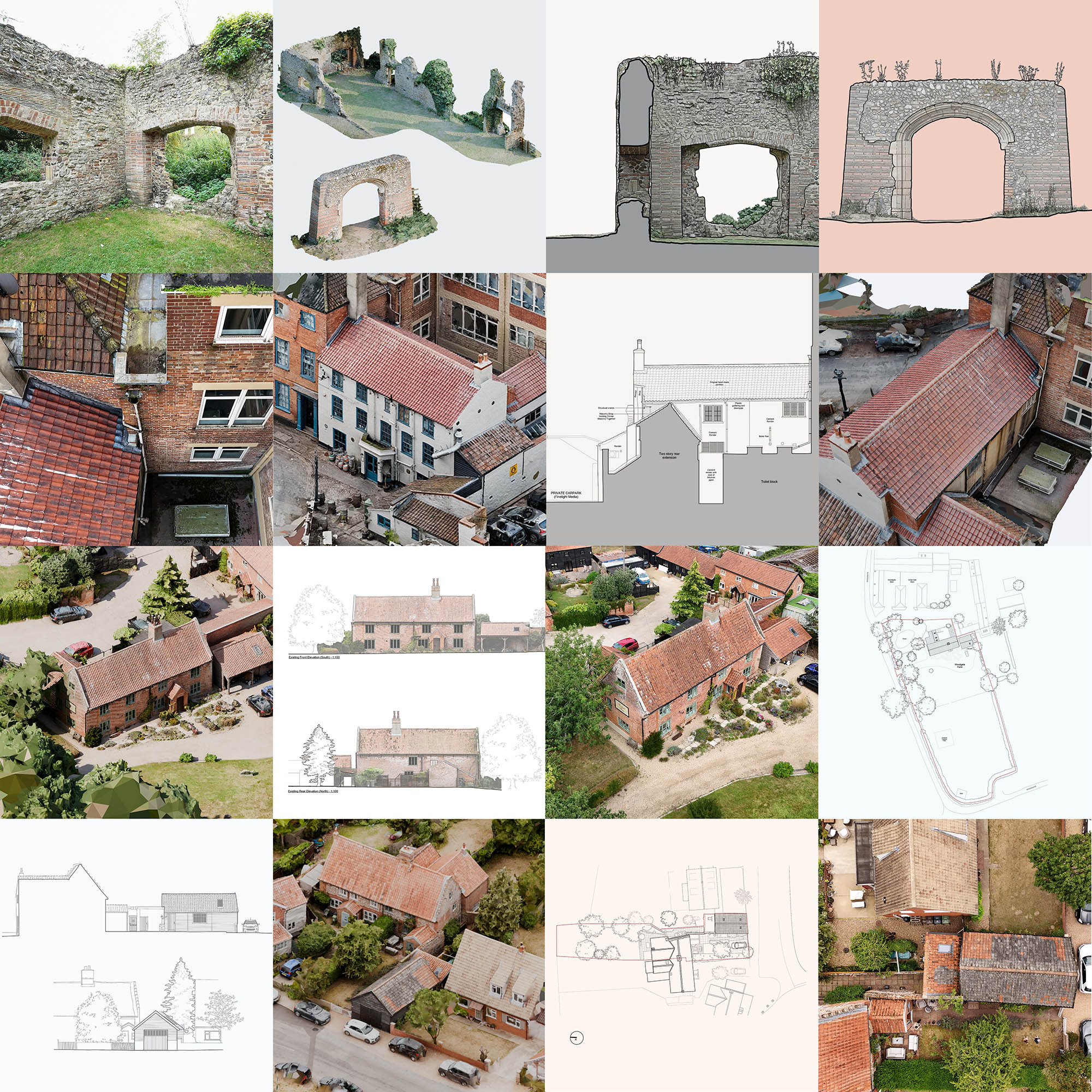
Photogrammetry allows for the digital documentation of accurate, detailed 3D records of buildings and landscapes using calibrated photography. This method is especially useful for heritage structures, components with a high degree of ornamentation, irregular geometries, or areas that are difficult to measure conventionally. I can document entire structures or isolate smaller, complex sections where traditional surveying becomes inefficient or inaccurate.
From the resulting 3D model, I can generate precise orthographic elevations, plans and annotated condition drawings that support design work, conservation planning and heritage documentation. The method offers a practical balance of speed, detail and accessibility, especially for historic fabric.
Note: Photogrammetry captures complex geometry, surface texture and material character extremely well, but it is not as dimensionally precise as laser scanning. Where possible, I cross-check the model against real-world measurements to verify key dimensions, but absolute accuracy cannot be guaranteed. For projects requiring millimetre-level tolerances, laser scanning may be more appropriate.
To request a photogrammetry survey or discuss a project, submit an enquiry through the contact form.
Photogrammetry allows for the digital documentation of accurate, detailed 3D records of buildings and landscapes using calibrated photography. This method is especially useful for heritage structures, components with a high degree of ornamentation, irregular geometries, or areas that are difficult to measure conventionally. I can document entire structures or isolate smaller, complex sections where traditional surveying becomes inefficient or inaccurate.
From the resulting 3D model, I can generate precise orthographic elevations, plans and annotated condition drawings that support design work, conservation planning and heritage documentation. The method offers a practical balance of speed, detail and accessibility, especially for historic fabric.
Note: Photogrammetry captures complex geometry, surface texture and material character extremely well, but it is not as dimensionally precise as laser scanning. Where possible, I cross-check the model against real-world measurements to verify key dimensions, but absolute accuracy cannot be guaranteed. For projects requiring millimetre-level tolerances, laser scanning may be more appropriate.
To request a photogrammetry survey or discuss a project, submit an enquiry through the contact form.
Photogrammetry allows for the digital documentation of accurate, detailed 3D records of buildings and landscapes using calibrated photography. This method is especially useful for heritage structures, components with a high degree of ornamentation, irregular geometries, or areas that are difficult to measure conventionally. I can document entire structures or isolate smaller, complex sections where traditional surveying becomes inefficient or inaccurate.
From the resulting 3D model, I can generate precise orthographic elevations, plans and annotated condition drawings that support design work, conservation planning and heritage documentation. The method offers a practical balance of speed, detail and accessibility, especially for historic fabric.
Note: Photogrammetry captures complex geometry, surface texture and material character extremely well, but it is not as dimensionally precise as laser scanning. Where possible, I cross-check the model against real-world measurements to verify key dimensions, but absolute accuracy cannot be guaranteed. For projects requiring millimetre-level tolerances, laser scanning may be more appropriate.
To request a photogrammetry survey or discuss a project, submit an enquiry through the contact form.
© 2025 Thomas Ewing. All rights reserved.
© 2025 Thomas Ewing. All rights reserved.