Thomas Ewing
Architecture + Design
Thomas Ewing
Architecture + Design
Thomas Ewing
Architecture + Design


Bridgefoot Cottage Barn
Location: Bawburgh, Norfolk
Role: Principle Designer
Stage/Service: Survey, Feasibility Study, Planning Permission
Typology: Grade II Listed, Barn Conversion, Holiday Let
Scale: 36m²
Year/Status: 2024 - Ongoing
Bridgefoot Cottage Barn
Location: Bawburgh, Norfolk
Role: Principle Designer
Stage/Service: Survey, Feasibility Study, Planning Permission
Typology: Grade II Listed, Barn Conversion, Holiday Let
Scale: 36m²
Year/Status: 2024 - Ongoing
Bridgefoot Cottage Barn
Location: Bawburgh, Norfolk
Role: Principle Designer
Stage/Service: Survey, Feasibility Study, Planning Permission
Typology: Grade II Listed, Barn Conversion, Holiday Let
Scale: 36m²
Year/Status: 2024 - Ongoing
Bridgefoot Cottage Barn
Location: Bawburgh, Norfolk
Role: Principle Designer
Stage/Service: Survey, Feasibility Study, Planning Permission
Typology: Grade II Listed, Barn Conversion, Holiday Let
Scale: 36m²
Year/Status: 2024 - Ongoing
Bridgefoot Cottage Barn
Location: Bawburgh, Norfolk
Role: Principle Designer
Stage/Service: Survey, Feasibility Study, Planning Permission
Typology: Grade II Listed, Barn Conversion, Holiday Let
Scale: 36m²
Year/Status: 2024 - Ongoing
Set within the curtilage of the Grade II listed Bridgefoot Cottage, this timber-framed barn has been a defining feature of Bawburgh’s village context since the early 19th century. Having undergone multiple alterations; including its physical relocation, re-roofing from thatch to pantiles, and the adaptation of its openings, the building’s layered history continues to evolve moving into the 21st century.
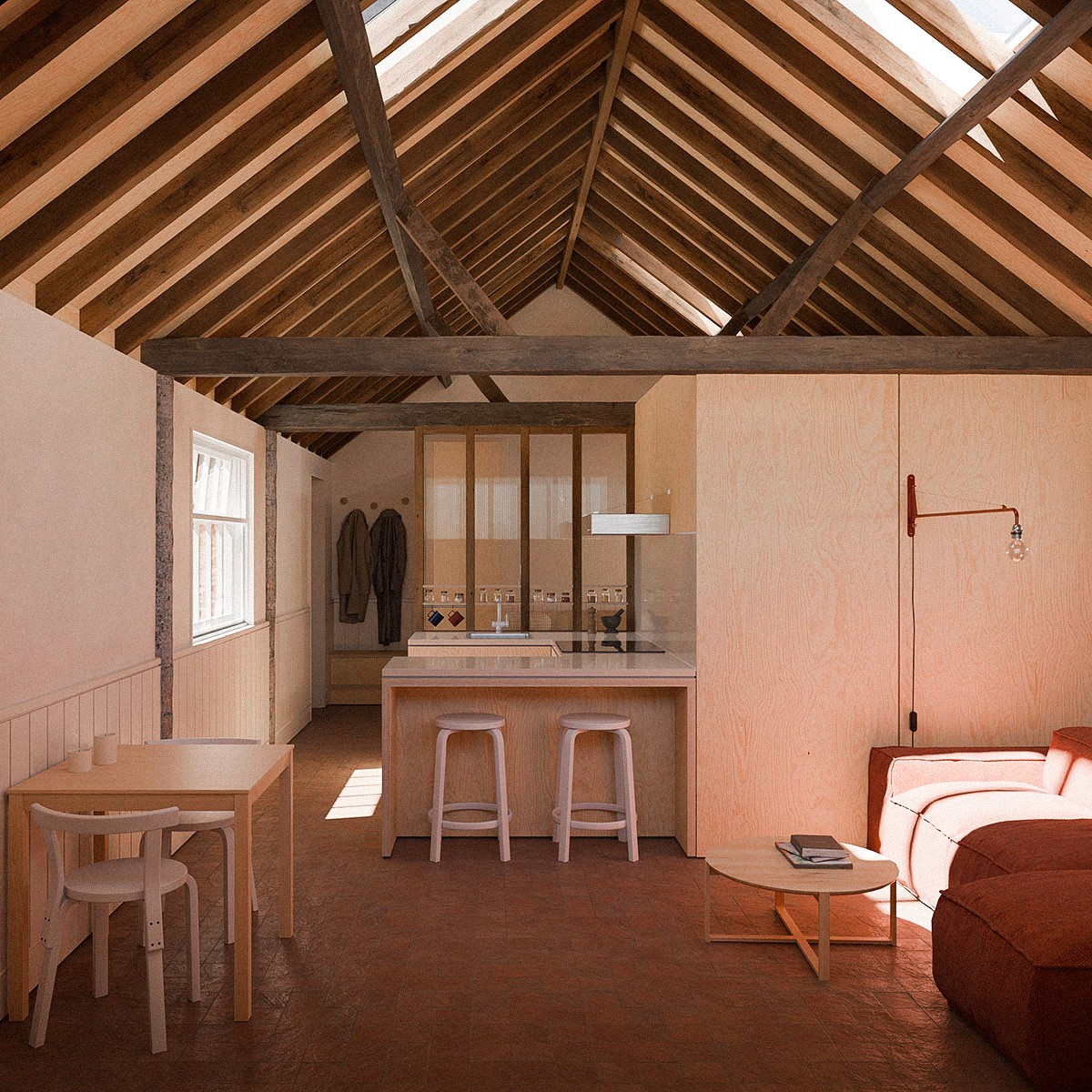
This project reimagines the modest 36m² barn as a one-bedroom holiday let, balancing the preservation of historic fabric with the requirements of contemporary life. The semi-open plan configuration utilises carefully placed partitions, obscured glazing, and built-in storage to enhance circulation, natural light, and visual continuity, creating a sense of generosity within a compact volume. The central kitchen and bathroom module clarifies spatial relationships, while new high-level windows and rooflights bring daylight deep into the interior.
The result is a calm, spatially efficient retreat that celebrates the barn’s modest scale and enduring rural identity through thoughtful adaptation.
Set within the curtilage of the Grade II listed Bridgefoot Cottage, this timber-framed barn has been a defining feature of Bawburgh’s village context since the early 19th century. Having undergone multiple alterations; including its physical relocation, re-roofing from thatch to pantiles, and the adaptation of its openings, the building’s layered history continues to evolve moving into the 21st century.
This project reimagines the modest 36m² barn as a one-bedroom holiday let, balancing the preservation of historic fabric with the requirements of contemporary life. The semi-open plan configuration utilises carefully placed partitions, obscured glazing, and built-in storage to enhance circulation, natural light, and visual continuity, creating a sense of generosity within a compact volume. The central kitchen and bathroom module clarifies spatial relationships, while new high-level windows and rooflights bring daylight deep into the interior.
The result is a calm, spatially efficient retreat that celebrates the barn’s modest scale and enduring rural identity through thoughtful adaptation.
Set within the curtilage of the Grade II listed Bridgefoot Cottage, this timber-framed barn has been a defining feature of Bawburgh’s village context since the early 19th century. Having undergone multiple alterations; including its physical relocation, re-roofing from thatch to pantiles, and the adaptation of its openings, the building’s layered history continues to evolve moving into the 21st century.
This project reimagines the modest 36m² barn as a one-bedroom holiday let, balancing the preservation of historic fabric with the requirements of contemporary life. The semi-open plan configuration utilises carefully placed partitions, obscured glazing, and built-in storage to enhance circulation, natural light, and visual continuity, creating a sense of generosity within a compact volume. The central kitchen and bathroom module clarifies spatial relationships, while new high-level windows and rooflights bring daylight deep into the interior.
The result is a calm, spatially efficient retreat that celebrates the barn’s modest scale and enduring rural identity through thoughtful adaptation.
Set within the curtilage of the Grade II listed Bridgefoot Cottage, this timber-framed barn has been a defining feature of Bawburgh’s village context since the early 19th century. Having undergone multiple alterations; including its physical relocation, re-roofing from thatch to pantiles, and the adaptation of its openings, the building’s layered history continues to evolve moving into the 21st century.
This project reimagines the modest 36m² barn as a one-bedroom holiday let, balancing the preservation of historic fabric with the requirements of contemporary life. The semi-open plan configuration utilises carefully placed partitions, obscured glazing, and built-in storage to enhance circulation, natural light, and visual continuity, creating a sense of generosity within a compact volume. The central kitchen and bathroom module clarifies spatial relationships, while new high-level windows and rooflights bring daylight deep into the interior.
The result is a calm, spatially efficient retreat that celebrates the barn’s modest scale and enduring rural identity through thoughtful adaptation.
Set within the curtilage of the Grade II listed Bridgefoot Cottage, this timber-framed barn has been a defining feature of Bawburgh’s village context since the early 19th century. Having undergone multiple alterations; including its physical relocation, re-roofing from thatch to pantiles, and the adaptation of its openings, the building’s layered history continues to evolve moving into the 21st century.
This project reimagines the modest 36m² barn as a one-bedroom holiday let, balancing the preservation of historic fabric with the requirements of contemporary life. The semi-open plan configuration utilises carefully placed partitions, obscured glazing, and built-in storage to enhance circulation, natural light, and visual continuity, creating a sense of generosity within a compact volume. The central kitchen and bathroom module clarifies spatial relationships, while new high-level windows and rooflights bring daylight deep into the interior.
The result is a calm, spatially efficient retreat that celebrates the barn’s modest scale and enduring rural identity through thoughtful adaptation.
© 2025 Thomas Ewing. All rights reserved.
© 2025 Thomas Ewing. All rights reserved.