Thomas Ewing
Architecture + Design
Thomas Ewing
Architecture + Design
Thomas Ewing
Architecture + Design


Newton Hall Ruins
Location: Trowse with Newton, Norfolk
Role: Heritage Consultant
Stage/Service: Masonry Condition Survey
Typology: Grade II Listed, 15th Century Country House Ruins
Year/Status: 2024
Newton Hall Ruins
Location: Trowse with Newton, Norfolk
Role: Heritage Consultant
Stage/Service: Masonry Condition Survey
Typology: Grade II Listed, 15th Century Country House Ruins
Year/Status: 2024
Newton Hall Ruins
Location: Trowse with Newton, Norfolk
Role: Heritage Consultant
Stage/Service: Masonry Condition Survey
Typology: Grade II Listed, 15th Century Country House Ruins
Year/Status: 2024
Newton Hall Ruins
Location: Trowse with Newton, Norfolk
Role: Heritage Consultant
Stage/Service: Masonry Condition Survey
Typology: Grade II Listed, 15th Century Country House Ruins
Year/Status: 2024
Newton Hall Ruins
Location: Trowse with Newton, Norfolk
Role: Heritage Consultant
Stage/Service: Masonry Condition Survey
Typology: Grade II Listed, 15th Century Country House Ruins
Year/Status: 2024
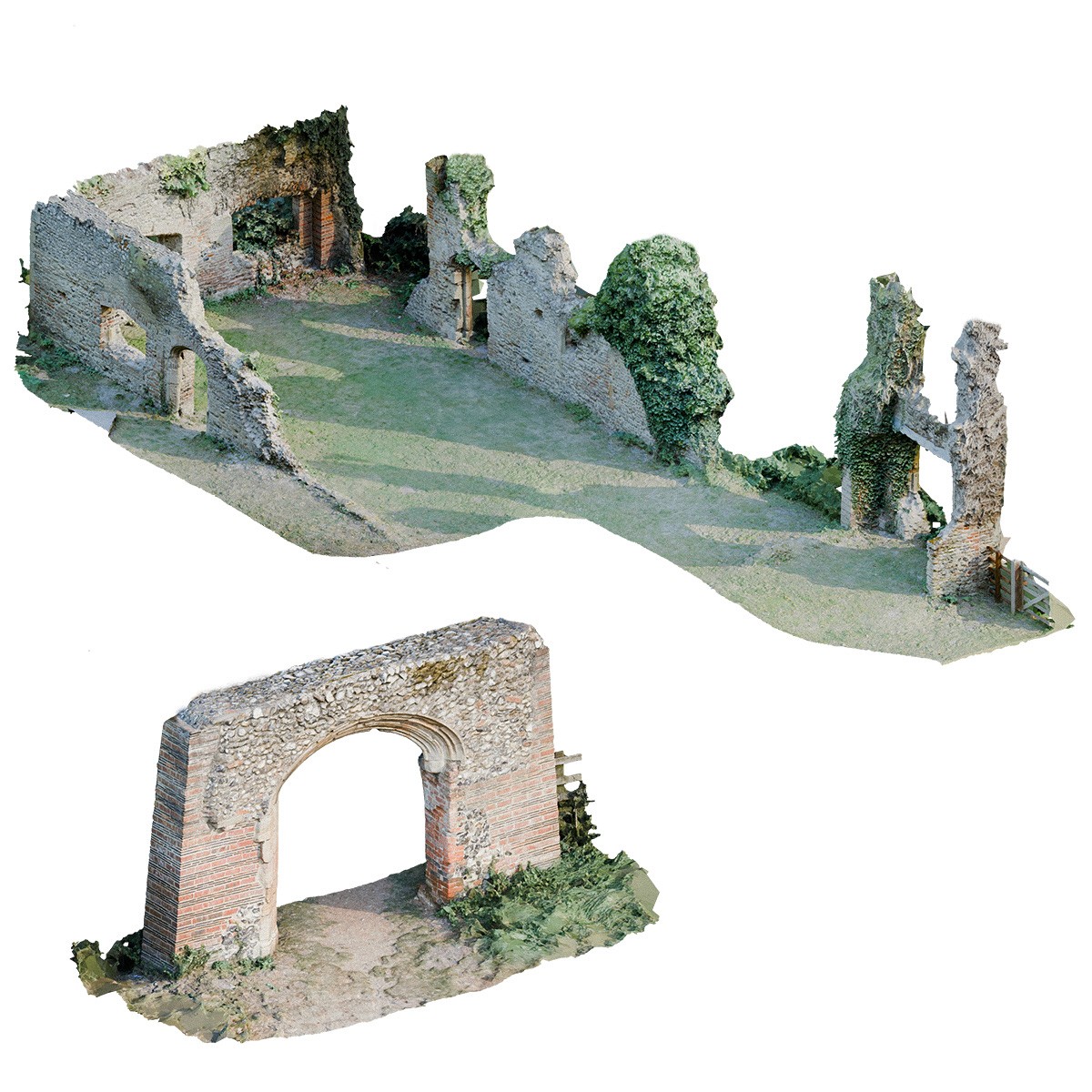
Newton Hall, a scheduled ruin in Norfolk, presents a complex mix of surviving medieval and post-medieval masonry. The standing walls show extensive weathering, structural movement, and patchwork repairs that make a conventional survey unreliable. To document the site accurately, I carried out a full photogrammetric scan of the remaining fabric and used the resulting model to produce detailed orthographic elevations.
The drawings mapped the condition of every accessible face of the ruin, including areas of masonry loss, differential decay, open joints, vegetation growth, and historic interventions. Each elevation was annotated with targeted remedial recommendations, ranging from selective repointing and consolidation to vegetation removal and localised rebuilding, providing a clear framework for conservation-led repair.
The exercise served as a useful case study in how digital survey methods can support the stewardship of fragile heritage assets. Using photogrammetry allowed the structure to be recorded with a level of precision that would be impractical through traditional methods, producing a durable record that can inform future repair, monitoring, and management of the site.
Newton Hall, a scheduled ruin in Norfolk, presents a complex mix of surviving medieval and post-medieval masonry. The standing walls show extensive weathering, structural movement, and patchwork repairs that make a conventional survey unreliable. To document the site accurately, I carried out a full photogrammetric scan of the remaining fabric and used the resulting model to produce detailed orthographic elevations.
The drawings mapped the condition of every accessible face of the ruin, including areas of masonry loss, differential decay, open joints, vegetation growth, and historic interventions. Each elevation was annotated with targeted remedial recommendations, ranging from selective repointing and consolidation to vegetation removal and localised rebuilding, providing a clear framework for conservation-led repair.
The exercise served as a useful case study in how digital survey methods can support the stewardship of fragile heritage assets. Using photogrammetry allowed the structure to be recorded with a level of precision that would be impractical through traditional methods, producing a durable record that can inform future repair, monitoring, and management of the site.
Newton Hall, a scheduled ruin in Norfolk, presents a complex mix of surviving medieval and post-medieval masonry. The standing walls show extensive weathering, structural movement, and patchwork repairs that make a conventional survey unreliable. To document the site accurately, I carried out a full photogrammetric scan of the remaining fabric and used the resulting model to produce detailed orthographic elevations.
The drawings mapped the condition of every accessible face of the ruin, including areas of masonry loss, differential decay, open joints, vegetation growth, and historic interventions. Each elevation was annotated with targeted remedial recommendations, ranging from selective repointing and consolidation to vegetation removal and localised rebuilding, providing a clear framework for conservation-led repair.
The exercise served as a useful case study in how digital survey methods can support the stewardship of fragile heritage assets. Using photogrammetry allowed the structure to be recorded with a level of precision that would be impractical through traditional methods, producing a durable record that can inform future repair, monitoring, and management of the site.
© 2025 Thomas Ewing. All rights reserved.
© 2025 Thomas Ewing. All rights reserved.